Wednesday, 1 August 2018
Paint it Black
The Caldwell-Hill house is located on Robie Street in Halifax. Near the junction with Jubilee Road. It has some spooky tales concerning its 'black window'. The window is on the side of the house facing Jubilee Road.
The story I heard was that a woman had been killed in there and after the house was sold, people on the outside could see a ghostly image of a woman inside the home. The house was sold again and the subsequent owners painted the window black so no-one could look in and see a ghost, but the window cracked; every time it was replaced and painted black, it cracked. So eventually, the glass was removed and boarded up with the board being painted black.
There are a range of stories some involving a man who hung himself on the tree outside and witches dancing on the veranda!
The house is referenced on Wikipedia too.
Every time I drive past it I hum Paint it Black by The Rolling Stones!

Thursday, 19 July 2018
Sci-Fi & songs & other things
In the early 1970's, Chariots of the Gods was a very popular book that everyone had an opinion about. In it Von Däniken, the author, posits a variety of hypotheses dealing with the possibility of 'extraterrestrial beings' influencing ancient technology. Von Däniken suggests that some ancient structures and artifacts appear to represent higher technological knowledge than is presumed to have existed at the times they were manufactured. The people around me, friends or workers, all seemed to read alien affects into everything. We had many interesting discussions around alien influences and where they may be referenced. The song Longer Boats, from Cat Stevens, falls into this category. Longer Boats is from Cat Stevens' "Tea for the Tillerman" album. The lyrics refer to the "Longer Boats are coming to win us." We thought Cat was singing of alien spaceships... I remember some interesting evenings talking with friends about the allusion. In a 1973 interview, Cat Stevens does allude to flying saucers in a dream that made him think of the lyrics when he woke up. Well, what can I say?!!
Playlist
Longer Boats - Cat Stevens
What Can I Say - Boz Scaggs
p.s. of course, Cat Stevens is now known as Yusef Islam.
Saturday, 30 June 2018
folk music & more
As a schoolboy meeting up with friends on a Friday morning in school we loved to pour over the weekly music papers The two favored ones were The New Musical Express and The New Record Mirror. As we we developed into blues & jazz fans we also read Melody Maker. A more "cultured" music paper (!)
In the UK from our pre-teen interest in "Trad Jazz" we moved on to folk tunes, blues tunes and the solo singer guitarist styles that was exemplified by Bob Dylan. Trad Jazz had began incorporating those anyway. Then the Beatles hit the scene and nothing was the same again. They went from simple, but catchy pop to highly experimental and even avant guard material. (Just listen to Revolution #9 on the White Album".)
In the UK from our pre-teen interest in "Trad Jazz" we moved on to folk tunes, blues tunes and the solo singer guitarist styles that was exemplified by Bob Dylan. Trad Jazz had began incorporating those anyway. Then the Beatles hit the scene and nothing was the same again. They went from simple, but catchy pop to highly experimental and even avant guard material. (Just listen to Revolution #9 on the White Album".)
Everyone wondered what music style would replace the Beatles & the so-called 'English sounds' that had filled the airwaves & charts from February 1964 onward in America. Well, much of the musical acts that grew in popularity in the 1970's right up to today, were already performing in the late sixties. I am not talking about the solo Beatles the Stones or Dylan. One classic example is Carole King and her hit with "Will You Love me Tomorrow." It was a tune she and her previous husband Gerry Goffin wrote for the Shirelles. It was on her massive selling album. Tapestry. Tapestry changed the landscape for female singers. In a way that Joni Mitchell had not quite managed yet. She certainly left a mark after Ladies of the Canyon and Blue. Check out Joni Mitchell with "Willy". It is from the Ladies of the Canyon album from 1970.
Joni's song "Willy" was about her lover of that period, Englishman, Graham Nash. Graham says in his autobiography, Hard Tales, Willy was her nickname for him. Another group from the late 60's that dominated the arena circuit of the seventies were Crosby, Stills, Nash and Young. (Which included that same Graham Nash.)
At first much of the 'folk' songs became a very pop styled melody as the success of Australian group The Seekers or British Trio The Bachelors proved. Here is a 'folk song' that began as a Coca-cola advertisement that was a big hit -- "(I'd like to) Teach The World to Sing" from The New Seekers. They grew out of the Australian group The Seekers. When they disbanded in the early seventies, Keith Potger from the group got The New Seekers together to continue that style of singing. They did have some success throughout the 70's.
Another folk band from the sixties that changed into a electric folk rock style, but still incorporated traditional instruments were The Fairport Convention. They added Sandy Denny to their line up in the late sixties which is when I saw them. She wrote the lovely "Who knows where the Time Goes". Awhile back, I read White Bicycles by Joe Boyd. His book on life in the 1960's. He was an American who landed up in London at the start of the Beatles phenomenon and psychedelic movement. He helped run Middle Earth in London in the late 60's THE hippie club. He also managed bands and was involved with Sandy Denny who wrote Who knows where the time goes as I noted previously. He recognised it as a great song with potential. He hooked Sandy up with an agent who helped her set-up her copyright appropriately so that she could benefit from the royalties. So many artists get ripped off by people supposedly guiding their interests. It was a good move, as that song has been covered by dozens of artists. Including Judy Collins who named an early LP with this as the lead track.
PLAYLIST
Will You Love me Tomorrow - Carole King
Willy - Joni Mitchell
Teach Your Children - Crosby, Stills, Nash and Young
(I'd like to) Teach The World to Sing - The New Seekers
Who knows where the time goes done - Fairport Convention
PLAYLIST
Will You Love me Tomorrow - Carole King
Willy - Joni Mitchell
Teach Your Children - Crosby, Stills, Nash and Young
(I'd like to) Teach The World to Sing - The New Seekers
Who knows where the time goes done - Fairport Convention
Tuesday, 29 May 2018
Boeing 747 Jumbo Jet
I was still in London in January 1970 when the first Jumbo Jets went into service with Pan Am. I was standing on the Thames Embankment when one circled overhead on its approach to Heathrow. It looked immense; of course, it was!
Throughout the Seventies, as a bachelor with no mortgage or home-ownership items to spend my pay on and saving for retirement had not clicked-on in my brain, I spent my dollars on travel. Not bucket-list safari stuff but seeing family in 3 countries and friends on 3 continents.
Pretty soon I had flown on many Jumbos.
Those were interesting flights. You could ask for "upgrades" to First Class, and if there were a lot of those seats available, they would give them to you at no cost. Obviously, it was a teaser to encourage one to promote those extras that one received.
What I remember most, and fondly because I cannot imagine it happening now on commercial flights, was the bar where you could stand and drink your Johnny Walker Red with 2 ice cubes only!!
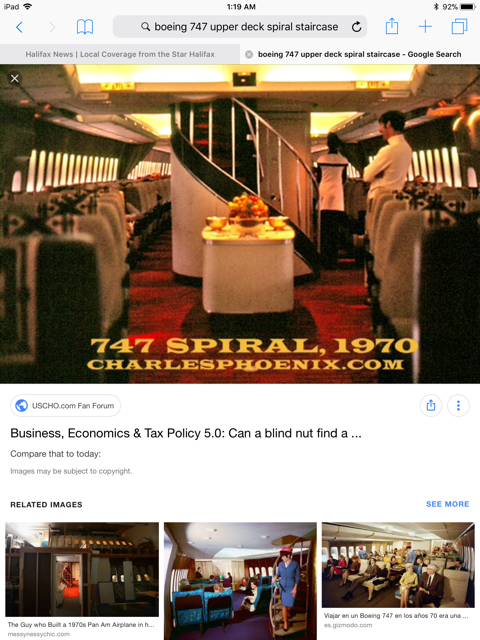
 Yes, there was a spiral staircase that took you up to the hump on the top of the plane where the seats were more like a lounge than the usual rows of seats.
 The lounge shown in the above picture was not the one I sat in but the only one I could find on the Internet at the moment. The comfy seat I had, was arranged more like a small room or the ones we see nowadays on private business jets.
I flew one time in a 747 First Class that was configured such that my seat was right in the front nose cone with a window directly in front of me. It was an awesome journey through the clouds!
Throughout the Seventies, as a bachelor with no mortgage or home-ownership items to spend my pay on and saving for retirement had not clicked-on in my brain, I spent my dollars on travel. Not bucket-list safari stuff but seeing family in 3 countries and friends on 3 continents.
Pretty soon I had flown on many Jumbos.
Those were interesting flights. You could ask for "upgrades" to First Class, and if there were a lot of those seats available, they would give them to you at no cost. Obviously, it was a teaser to encourage one to promote those extras that one received.
What I remember most, and fondly because I cannot imagine it happening now on commercial flights, was the bar where you could stand and drink your Johnny Walker Red with 2 ice cubes only!!

I flew one time in a 747 First Class that was configured such that my seat was right in the front nose cone with a window directly in front of me. It was an awesome journey through the clouds!
Friday, 18 May 2018
Youthful magic
The sixties gave birth to some of the best songwriters of the whole century whose music resonates still today. On my radio show, I limit myself to songwriters in English, but, the interesting thing is that these writers really had more of an impact on world music than Gershwin and Irving Berlin in the half century before. YouTube has Beatles tunes in many other languages to back up my point.
Another facet of the sixties' artists is their willingness even as songwriters themselves, to do each other's famous songs. [Here are two I played recently:Things we said today from the Beatles movie Hard Day's Night done by Bob Dylan. Then Dylan's If not for you done by George Harrison.]
One group that were eager to meld music and pop-art into rock were the Who. Their pop-art tune of Anyway, Anyhow, Anywhere is a classic example of how pop music at the time was very anti-establishment and trying to widen its influence. The Who's shows were quite the Happening back then. And if you don't know what a Happening is, then, any written explanation will simply fall flat. As the saying goes, you had to be there.
If you were young and a music lover in the UK in the sixties, your weekend began with Ready, Steady Go. The youth show for quite awhile. Its first theme song was 5-4-3-2-1 from Manfred Mann. It was released as a single and was their first hit. They went on to many more hits. Made great interpretations of Dylan tunes too.
Liverpool was not only home to a great number of groups that found fame in Britain and the rest of the World when the youthful music and joy of the Beatles became a true sociological phenomenon. However, it was not just music that caught our attention. There was a vibrant arts scene there too, specifically poets and poetry readings. When I say they attracted attention, I'm not kidding. One particular group, incorporated poetry and music into their act and have carved out a career as long as the Beatles. It was the Scaffold. They had a number of pop hits and even a No.1 chart hit, Lily the Pink. The Scaffold consisted of 3 people, Mike McGear, real name Michael McCartney, yes, Paul's brother, John Gorman and Roger McGough. McGough was a poet, who along with Brian Patten and Adrian Henri had a Penguin Modern Poets Volume 10 published to huge success. My friends and I all bought it and read it constantly. Their style was modern and very much sounded like the life we wished to live. It has gone on to become the most successful poetry publication in Penguins long list of poetry books.
Ah, we were full of bliss under our blue suburban skies. (Thank you Penny Lane.)
Saturday, 28 April 2018
women's suffrage, Michael and music
2018 marks the 100th anniversary of women's suffrage in Nova Scotia. Specifically, April 26, 1918 was the date the bill was passed in the Provincial Legislature. Other Provinces celebrate other dates. Britain also marks its 100th anniversary this year; However, none were universal suffrage; there were limits to women. For example, being 30 or older, Homeowners or married to Homeowners. Wider enfranchisement came later.
I arrived in Canada on March 15th 1970. I was sleeping on a friend's "Davenport". Couch surfing before it was a thing. I had no job, only a suitcase and dreams. There were no Sunday papers, so 6 days a week I scoured the classified columns for employment, which was scant at that moment. But I did enjoy reading the paper from front sheet to back. There was a lot of talk about the "Women;s movement". Possibly sparked by the March 20th news item -
Betty Friedan gave her farewell address as outgoing president of NOW (the National Organization of Women), and called for a nationwide women’s strike on August 26 (the 50th anniversary of winning the vote. Although, it took the 1965 Voting Rights Act to ensure Black women could execute that right which the 19th Amendment should have granted in 1920.) As the momentum for a women's march built, and the myth of bra-burners gathered steam, I found most of the people in my new circle were strongly modernists in their outlook. The circle of friends and acquaintances all supported a wider role for women in society. That included the males.
As noted above, Women getting the vote, women working side by side with men in factories throughout two wars, was not enough to break the many barriers that women faced in life. Regardless of race, ethnicity or status. It was these invisible, but very durable barriers that women needed to break.
Women had been successful in music and the entertainment industry in limited numbers, but the music itself did not address their struggle and receive wide distribution.
It took until 1971 for music to catch up.
Helen Reddy's feminine anthem I am Woman, was out in 1971 on her debut LP but was not a single until 1972 when it topped the charts. Of course, it went on to win the Grammy for single of the year and in her acceptance speech, Helen Reddy, thanked a female God. It was a pivotal moment for increasing awareness of the issue. Also in 1971, Carly Simon released That's The Way. Although that shortened title belies the mood of the song which the full sentence conveys very well: That's the Way I've Always Heard It Should Be". It's about a young woman coming of age and seeing her parents unhappy marriage & friends mindlessly settling down and giving up on their dreams.Not sure why, but I bought the 45 when I did not have a record player. Still have it in fact. (Just to re-deem myself, let me clarify, I had a cassette player & a friend put it on a cassette for me to hear in my bare bones bachelor apartment!)
These are the Helen and Carly numbers:
I am Woman - Helen Reddy
That's The Way - Carly Simon
A final thought, regardless of these decades of increasing power and control for women, the #metoo movement has made it clear that society has far to go still. If you are young and powerless when seeking employment, women face not just "barriers" but harassment as men remain the gatekeepers to the entry to so many paths. Mind you, it is clear, young men face similar harassment in many industries, too.
A final thought, regardless of these decades of increasing power and control for women, the #metoo movement has made it clear that society has far to go still. If you are young and powerless when seeking employment, women face not just "barriers" but harassment as men remain the gatekeepers to the entry to so many paths. Mind you, it is clear, young men face similar harassment in many industries, too.
Tuesday, 17 April 2018
Skip Spence
Skip Spence was born in Windsor Ontario but grew up in America. He was born on April 18, 1946.
He was one of the early members of Jefferson Airplane. I loved Jefferson Airplane in their early days and played Surrealistic Pillow again and again in the late 60s and right up to the 21st-century. But Skip apparently was a troubled soul. he left the airplane and joined a bunch of other groups before cofounding Moby Grape, another great 60s band.
I met Skip in London in a friends flat in Tottenham Court Road. It was August 1969 Skip had flown in to see the free concert that Blind Faith was putting on in Hyde Park and my friends and I had gone as well and when I return to my friend’s flat, his flatmate introduced me to Skip. They had become friends when he was studying in California. I have to admit I was a little silly and starstruck and didn’t say anything sensible. And that particular day though Skip was full of fun and bright, and didn’t foreshadow a terrible breakdowns that he suffered in the 70s .
Skip wrote My Best Friend, a lovely tune the Airplane put on Surrealistic Pillow.
He was one of the early members of Jefferson Airplane. I loved Jefferson Airplane in their early days and played Surrealistic Pillow again and again in the late 60s and right up to the 21st-century. But Skip apparently was a troubled soul. he left the airplane and joined a bunch of other groups before cofounding Moby Grape, another great 60s band.
I met Skip in London in a friends flat in Tottenham Court Road. It was August 1969 Skip had flown in to see the free concert that Blind Faith was putting on in Hyde Park and my friends and I had gone as well and when I return to my friend’s flat, his flatmate introduced me to Skip. They had become friends when he was studying in California. I have to admit I was a little silly and starstruck and didn’t say anything sensible. And that particular day though Skip was full of fun and bright, and didn’t foreshadow a terrible breakdowns that he suffered in the 70s .
Skip wrote My Best Friend, a lovely tune the Airplane put on Surrealistic Pillow.
Subscribe to:
Posts (Atom)